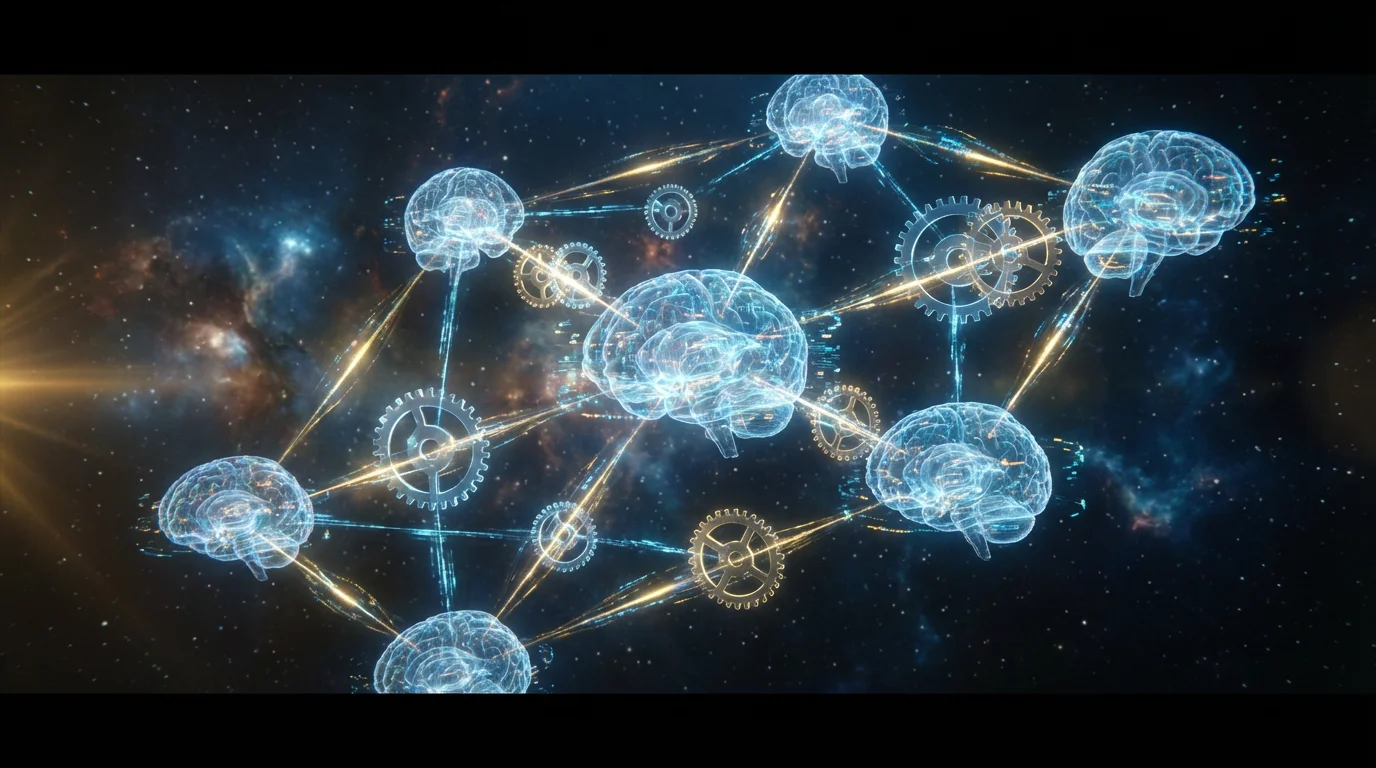
In the early days of AI, we were taught to interact with a single “chatbot.” We asked a question, and the chatbot gave an answer. But as we move into 2026, the paradigm is changing. We are entering the era of Multi-Agent Systems (MAS).
Imagine instead of one overworked assistant trying to do everything, you had a specialized “Digital Department.” In this department, one agent is a researcher, another is a writer, and a third is a project manager. They don’t just talk to you; they talk to each other. They critique each other’s work, share data, and collaborate to achieve a common goal. This is the multi-agent revolution, and it is how small businesses are scaling their operations in ways that were once impossible.
—
Beyond the Single Bot: What is a Multi-Agent System (MAS)?
At its core, a Multi-Agent System (MAS) is a network of specialized AI agents that work together to solve complex tasks. Unlike a single, general-purpose LLM (like GPT-4), which can sometimes become overwhelmed by multi-step instructions, MAS breaks the problem down.
Each agent has a specific persona, role, and set of tools. For example, a “Legal Review Agent” might have access to a database of contracts, while a “Financial Analyst Agent” might have access to your bank’s API. They collaborate through a “Manager Agent” that orchestrates the workflow.
Why MAS is Better than One Bot:
- Reduced Hallucinations: When one agent drafts and another critiques, the chance of error drops significantly.
- Task Specialization: Agents can be optimized for specific jobs (e.g., one for creative writing, one for precise code).
- Scalability: You can add more agents to your “team” as your business needs grow, without training a new human hire.
- Researcher Agent: Monitored Google Trends and Reddit for “Underrated European destinations for 2026.”
- Writer Agent: Took the top 3 destinations from the researcher and wrote a 1,500-word SEO-optimized guide for each.
- Manager Agent (The Orchestrator): Used an automation platform (like CrewAI or AutoGen) to ensure the writer only started once the researcher had verified the data. The Manager then sent the final draft to the owner’s Slack for a 1-click review.
- Output: Increased from 1 blog post per week to 1 blog post *per day*.
- Engagement: Increased by 45% because the content was always based on real-time trending data.
- Time Saved: The owner’s time spent on content dropped from 20 hours to just 20 minutes a week (for final review).
- Agent Logs: Regularly checking the logs to see how agents are communicating. Are they getting stuck in a loop? Are they misunderstanding each other’s handoffs?
- Iterative Prompting: If the Editor Agent is consistently missing a specific brand rule, you must update its “System Prompt.”
- Human-in-the-Loop: For high-stakes tasks (like payments or client-facing emails), always keep a human approval step in the workflow.
—
The “Digital Department” Concept: Roles, Tasks, and Hand-offs
Building a multi-agent revolution within your business requires thinking like a manager. You need to define the roles and how they will hand off work to each other.
The Typical AI Department Structure:
1. The Researcher Agent: Scours the web, scrapes data, and provides raw facts.
2. The Writer/Creator Agent: Takes the researcher’s facts and turns them into an article, a report, or a social media post.
3. The Editor/Critic Agent: Reviews the draft for accuracy, tone, and brand consistency.
4. The Manager Agent: Oversees the entire process, manages timelines, and delivers the final product to you for approval.
The Hand-off:
The key to MAS success is the “handoff.” When the Researcher finishes, it doesn’t just stop; it sends a structured JSON or Markdown file to the Writer. The Writer then notifies the Editor. This seamless data flow is what makes an AI workforce for small business so powerful.
—
[Case Study] How a Researcher, a Writer, and a Manager Agent Built a Content Empire
The Company: “TravelWise,” a boutique travel consultancy.
The Problem: The owner spent 20 hours a week researching new destinations and writing blog posts to attract clients.
The Solution: A Multi-Agent Content Silo.
The Results:
—
Popular Frameworks for Multi-Agent Orchestration in 2026
If you want to build your own multi-agent systems (MAS), these are the leading frameworks and platforms in 2026:
1. CrewAI: One of the most popular frameworks for creating “crews” of agents. It is highly intuitive and allows you to define tasks and roles with ease.
2. Microsoft AutoGen: A more technical framework designed for complex, conversational agent interactions. It’s ideal for multi-step reasoning tasks.
3. LangGraph: A powerful tool for building “stateful” agentic workflows where the AI remembers previous steps and can loop back if a task fails.
4. Zapier Central (Multi-Agent Mode): A no-code way to have multiple “brains” in your Zapier account talking to each other.
—
Managing Your AI Workforce: Monitoring, Feedback, and Quality Control
Just because your agents are AI doesn’t mean you can leave them completely unsupervised. Managing an AI workforce requires:
—
Why Collaboration is the Key to Scaling AI Automation
The future of productivity is not about one person doing everything, nor is it about one AI doing everything. It is about a multi-agent revolution where specialized agents collaborate to handle the complexity of modern business. By building your first “Digital Department” today, you are giving your small business the leverage to compete with giants.
—
*Follow juyq.com for more deep-dives into AI-driven productivity and smart living strategies.*