In 2011, Marc Andreessen famously said that “software is eating the world.” For the next decade, “learning to code” was the ultimate career advice. But as we navigate the landscape of 2026, the paradigm is shifting again. Software is no longer being written line-by-line by humans; it is being *composed* by intelligent agents.
The most valuable skill in 2026 is no longer writing the code itself—it is AI agent orchestration. As businesses move from simple chatbots to autonomous “digital departments,” the role of the AI Solutions Architect has become the highest-paid and most critical position in the modern economy.
This is the final chapter of our initial JUYQ Intelligence 2026 AI Playbook. In this guide, we’ll explore the evolution of the AI professional and how you can future-proof your career in an agentic economy.
—
From Prompting to Orchestrating: The Evolution of the AI Professional
Just a few years ago, the “Prompt Engineer” was the buzzword. People were paid to find the “magic words” to get a response from an LLM. But as AI has become more sophisticated, simple prompting is no longer enough.
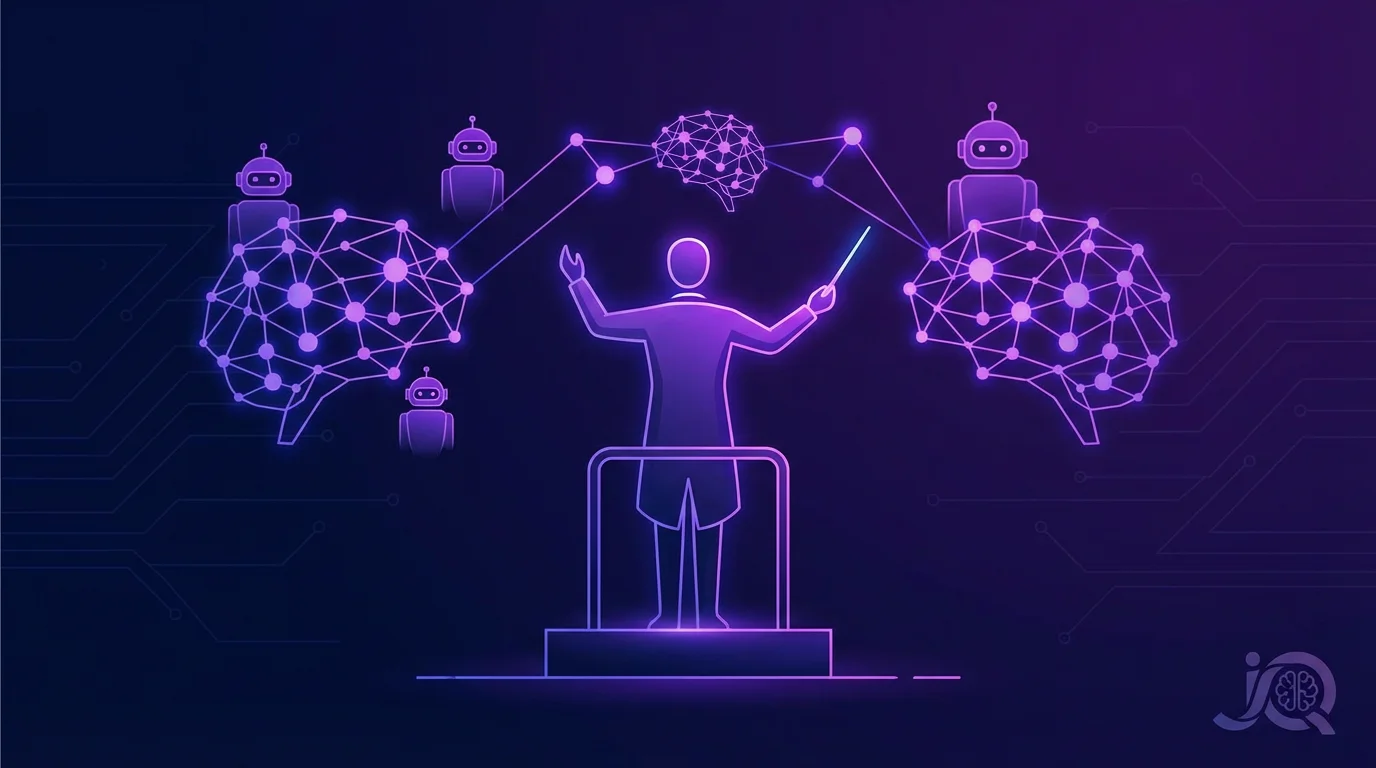
In 2026, we have moved from Prompting (asking for an answer) to Orchestrating (managing a process). An Orchestrator doesn’t just ask an AI a question; they design a system where multiple AIs—each with their own tools and roles—work together to achieve a business outcome. This is the difference between asking a chef for a recipe and managing a five-star restaurant.
—
What is AI Agent Orchestration? (And Why It’s Replacing Traditional Dev Roles)
AI Agent Orchestration is the art and science of coordinating multiple autonomous agents to perform complex, multi-step tasks.
In 2026, many traditional software development roles—like front-end coding or database management—have been automated. The new bottleneck isn’t “writing the code,” but defining the logic of how agents should collaborate.
An AI Solutions Architect doesn’t sit in an Integrated Development Environment (IDE) all day. Instead, they work in orchestration frameworks like CrewAI, LangGraph, or Microsoft AutoGen, defining the “Rules of Engagement” for a digital workforce. They are the directors of a digital symphony.
—
The 3 Core Skills of the 2026 AI Solutions Architect
To thrive in this new economy, you need a new set of skills that go beyond technical coding:
Skill 1: Strategic Task Decomposition (The Business Brain)
The most important part of orchestration is breaking a complex goal (e.g., “Automate our customer onboarding”) into its smallest, most logical sub-tasks. An Orchestrator must understand the business process as well as the AI’s capabilities.
Skill 2: Multi-Agent System Design (The Orchestrator)
You must know how to assign the right “persona” and “tools” to each agent. For example, knowing that a “Researcher Agent” needs access to a search API, while a “Legal Agent” needs access to a private vector database. Designing the handoffs between these agents is the core of the job.
Skill 3: Outcome-Based Quality Audit (The Final Gatekeeper)
In 2026, we are moving from “Code Reviews” to “Outcome Audits.” The Orchestrator’s job is to design the feedback loops that ensure the agents are actually achieving the goal without hallucinating or leaking data. This is AI Governance in action.
—
[The JUYQ Roadmap] How to Future-Proof Your Career in an Agentic Economy
At JUYQ Intelligence, we believe the “Skills Gap” of 2026 will be defined by those who can manage AI and those who are managed by it. Here is your roadmap to leadership:
1. Stop Prompting, Start Building: Don’t just chat with an AI; try to build an automation using Zapier Central or Lindy.ai.
2. Master the Logic, Not the Syntax: You don’t need to know Python perfectly, but you *must* understand conditional logic, loops, and data structures.
3. Become a Domain Expert: The AI can code, but it doesn’t understand your industry’s specific pain points. The most successful Orchestrators are those who combine AI skills with deep expertise in fields like law, medicine, or finance.
—
[A Day in the Life] The 2026 AI Orchestrator
9:00 AM: Review the logs of the “Customer Support Crew.” One agent is struggling with a new shipping policy.
10:30 AM: Update the “System Prompt” for the Support Agent to include the new 2026 return rules.
1:00 PM: Design a new “Marketing Content Silo.” Coordinate a Researcher Agent, a Graphic Agent (Midjourney), and a Social Media Agent to post 50 personalized ads daily.
3:00 PM: Conduct a “Security Audit” on the Sales Agent to ensure it hasn’t been targeted by Prompt Injection attacks.
5:00 PM: Report a 40% increase in efficiency to the CEO.
—
High-Paying AI Careers: Salaries and Roles for 2026 and Beyond
The demand for these roles is skyrocketing. Here are the average salaries for 2026:
* AI Solutions Architect: $180,000 – $250,000+
* AI Agent Workflow Designer: $120,000 – $160,000
* AI Compliance & Security Auditor: $140,000 – $190,000
These roles are no longer “IT jobs.” They are the core of business strategy.
—
Conclusion: Don’t Just Use AI — Lead the AI Workforce
The multi-agent revolution is the greatest opportunity for professional growth since the invention of the internet. We have moved from the “Ask” era to the “Execute” era.
This concludes our first JUYQ Intelligence 2026 AI Playbook. You now have the knowledge to build, secure, and manage a digital workforce that scales your productivity to 10x and beyond. But knowledge is only the beginning. The real advantage comes from execution.
Join the JUYQ Intelligence community today. Let’s not just use the future; let’s build it together. Automate your life. Scale your success. This is just the beginning.
—
*Follow JUYQ Intelligence for the next phase of our AI Playbook series. The era of the agent is here.*